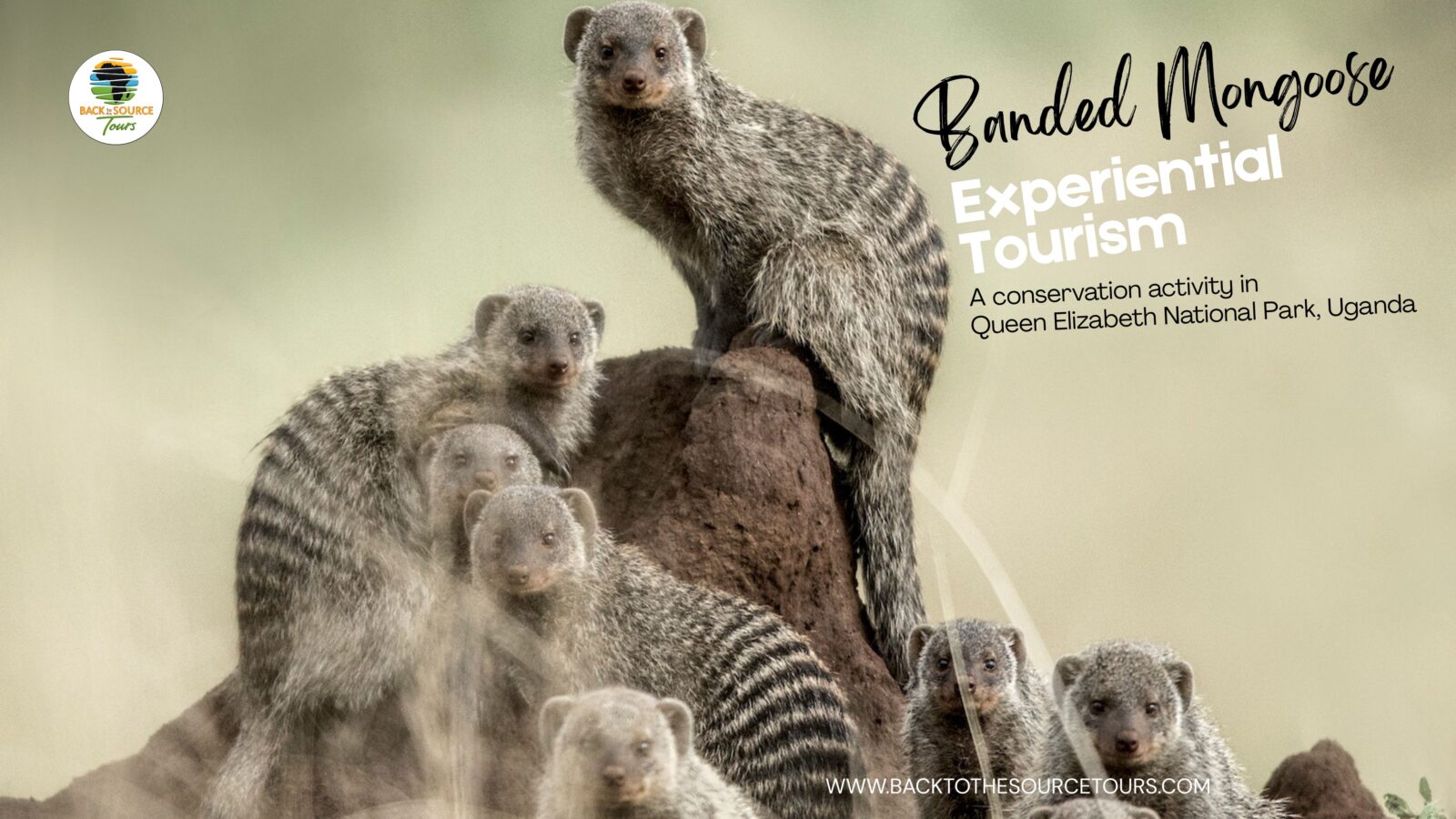
Banded mongoose tracking in Queen Elizabeth National Park gives travelers a closer look at one of Uganda’s most social and fascinating small mammals. This experience takes place around the Mweya Peninsula, one of the most scenic areas of Queen Elizabeth National Park. Here, travelers can learn how banded mongooses move, feed, communicate, protect their young, and live in highly organized family groups.
Although many visitors come to Queen Elizabeth National Park for lions, elephants, buffalo, hippos, leopards, and the Kazinga Channel, the mongoose tracking experience adds a different kind of wildlife story. Instead of watching animals from a safari vehicle only, travelers gain insight into field research, animal behavior, and conservation observation. As a result, this activity works well for wildlife lovers, families, photographers, students, and travelers who enjoy meaningful safari experiences beyond the standard game drive.
What Is the Banded Mongoose Research Project?
The Banded Mongoose Research Project studies the Mweya mongoose population in Queen Elizabeth National Park. The project brings together researchers working in Uganda and the United Kingdom, with the main project based at the University of Exeter and directed by Professor Michael Cant. The research uses the Mweya mongoose population to study cooperation, conflict, social behavior, and the evolution of animal societies.
The project began in 1995 and has grown into a major long-term study of social mammals. It supports more than 200 banded mongooses living in nine social groups. Over time, the research has helped generate more than 130 peer-reviewed scientific papers and train animal behavior researchers.
This matters for travelers because the activity connects tourism with real field research. Guests do not simply hear a short wildlife explanation and move on. Instead, they enter a living research environment where daily observations help build a long-term understanding of mongoose behavior. That makes the experience ideal for wildlife enthusiasts, conservation-minded travelers, students, photographers, and safari guests who want a more involved activity.
Where the Mongoose Tracking Experience Takes Place
The mongoose tracking experience takes place around the Mweya Peninsula in Queen Elizabeth National Park. This area sits within one of Uganda’s most biodiverse safari destinations, with open savannah, crater lakes, swamps, forest areas, and the famous Kazinga Channel. Queen Elizabeth National Park also supports lions, leopards, elephants, buffalo, hippos, chimpanzees, and more than 600 bird species.
The Mweya landscape gives the activity a special character. Banded mongooses move through thickets, grass patches, village edges, and open areas where wildlife roams freely. Waterbuck, buffalo, warthogs, elephants, monitor lizards, crocodiles, and snakes also occur around the peninsula. Therefore, the experience can feel surprisingly dynamic, even though the main focus remains the mongoose groups.
Place this activity into Queen Elizabeth itineraries that also include game drives, the Kazinga Channel boat cruise, Lake Katwe, Kyambura Gorge, Maramagambo Forest, or the Ishasha sector. This gives travelers a wider view of the park beyond the classic safari highlights. The experience can also fit into Back to the Source Tours Uganda itineraries that include Queen Elizabeth National Park, especially the 9 Day Adventure of Walking with Wildlife Tour and the 12 Day Uganda Safari Itinerary when timing and activity availability allow.
What Happens During Mongoose Tracking?
Mongoose tracking usually lasts about one to three hours. The activity often works best in the morning or evening, when wildlife movement can feel more active. Group size, access, and timing can depend on current park guidance, researcher availability, and activity coordination.
Tracking and Locating the Mongoose Groups
Guests join guides or researchers who help locate mongoose groups around Mweya. The activity can involve locator devices, habituation calls, and careful movement through areas linked to the research project. Once the team finds the mongoose group, guests observe how the animals move, forage, interact, communicate, and respond to their surroundings. This gives travelers a more detailed wildlife experience than a brief sighting during a standard drive.
Observing Behavior and Group Dynamics
Banded mongooses live in highly social groups, so the activity focuses strongly on behavior. Travelers may watch grooming, feeding, movement, alert behavior, juvenile care, group coordination, and interactions between individuals. Meanwhile, researchers and guides explain how these observations help reveal cooperation, conflict, social structure, and survival strategies within mongoose communities.
Collecting Research Data
The activity can include recording weather, habitat conditions, location, movement, behavior, and surrounding wildlife activity. These findings contribute to research databases and help strengthen the understanding of wildlife ecology in Queen Elizabeth National Park. Guests therefore support conservation knowledge while enjoying a memorable safari activity.
Why This Activity Counts as Experiential Tourism
Experiential tourism in Queen Elizabeth National Park allows travelers to participate in wildlife monitoring activities instead of only observing from a distance. Mongoose tracking fits this model because guests help follow, observe, and record information about banded mongoose groups. Other experiential tourism activities in the park can include lion tracking, bird counts, and hippo census experiences.
This style of tourism gives travelers a stronger connection to the park. A regular safari may show guests what animals look like. However, experiential tourism helps guests understand how animals behave, how researchers gather information, and why long-term monitoring matters. The mongoose activity works especially well because banded mongooses display constant movement, social interaction, and communication.
Why Banded Mongooses Are So Interesting
Banded mongooses may look small, but their social lives make them fascinating. They live in organized groups, move together, feed together, protect each other, and communicate often. Researchers study them because their behavior raises important questions about cooperation, conflict, family structure, aggression, reproduction, and group survival.
This makes the activity especially rewarding for travelers who enjoy animal behavior. Instead of waiting for one dramatic predator moment, guests watch small decisions unfold every few seconds. One mongoose may dig while another watches. Several may move as a coordinated unit. Younger animals may follow adults closely. Meanwhile, the whole group can change direction quickly when the environment shifts.
The experience also reminds travelers that safari value does not only come from large mammals. Lions, elephants, buffalo, and hippos deserve their reputation. However, smaller species often reveal the most detailed stories. Banded mongooses show how cooperation shapes survival in a wild landscape. That makes them one of Queen Elizabeth National Park’s most underrated wildlife experiences.
How Mongoose Tracking Supports Conservation Tourism
Mongoose tracking supports conservation tourism because it connects guest participation with long-term field research. During the activity, travelers help gather observations that researchers can use to understand mongoose ecology and behavior. This creates value beyond sightseeing. Guests leave with a stronger understanding of wildlife research, while the project gains visibility and support.
The activity also encourages travelers to respect smaller species and less obvious wildlife stories. Many safari itineraries focus heavily on large mammals, which makes sense for first-time travelers. Conservation depends on whole ecosystems. Mongooses, birds, reptiles, insects, wetlands, forests, and grasslands all help shape the health of Queen Elizabeth National Park.
A strong Uganda safari can include game drives, boat cruises, chimpanzee trekking, crater landscapes, cultural visits, and research based activities. When planned well, mongoose tracking adds a thoughtful conservation layer to a Queen Elizabeth National Park itinerary. It helps travelers understand the park as a living ecosystem, not only a place for large wildlife sightings.
Plan a Queen Elizabeth Safari With Mongoose Tracking
Banded mongoose tracking works best as part of a wider Queen Elizabeth National Park itinerary. Travelers can combine it with game drives, the Kazinga Channel boat safari, Kyambura Gorge, Lake Katwe, Maramagambo Forest, and the Ishasha sector for tree climbing lions. This creates a stronger safari because each activity shows a different side of the park.
Travelers interested in wildlife research, photography, animal behavior, or conservation should consider adding this activity when timing allows. Availability, park logistics, and activity timing can vary, so the experience should fit naturally into the route. It should support the safari, not overcrowd the day.
To include mongoose tracking in a Uganda safari, explore our East Africa tour packages or complete the Back to the Source Tours travel form. Share your travel dates, preferred pace, and the Queen Elizabeth activities you want to include.