

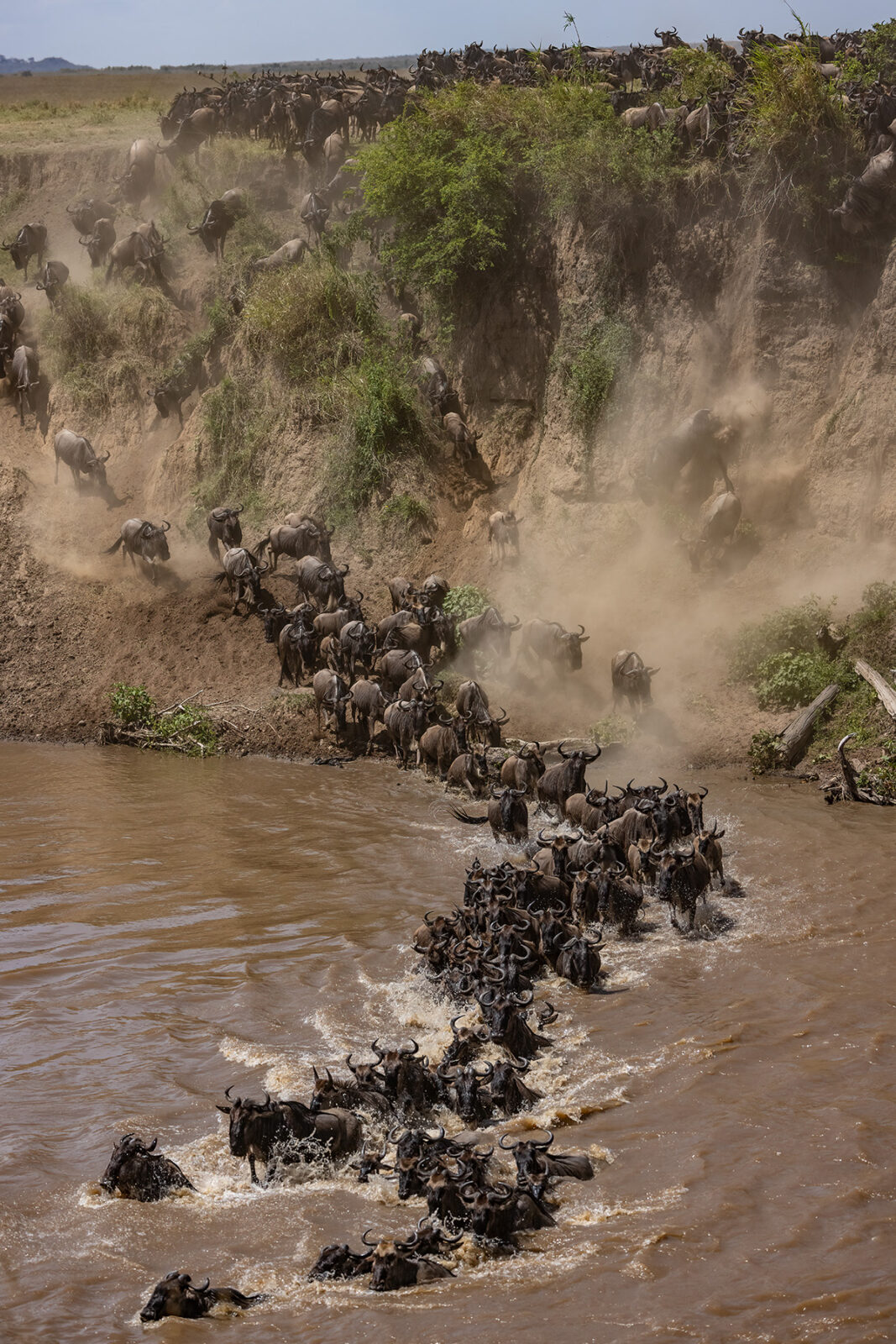
The Great Wildebeest Migration is one of the most extraordinary wildlife events on Earth, a continuous, year-round movement of over 1.5 million wildebeest, zebras, and gazelles across the plains of Kenya and Tanzania.
This is not a single event or a fixed moment in time. It is a circular journey driven by rainfall, fresh grass, and survival instincts that have shaped the Serengeti and Maasai Mara ecosystems for thousands of years.
For travelers planning a safari, understanding where the herds are and when to visit is essential. This guide breaks down the Great Wildebeest Migration month by month, including river crossings, calving season, and how to plan your safari experience for the best possible sightings.
Explore our Kenya safari itineraries designed around the migration season.
What Is the Great Wildebeest Migration?
Here is the core thing most people do not fully grasp until they see it: the migration is not a one-off event. It is not a specific crossing that happens in a specific week and then it is done for the year. It is a perpetual, circular journey with no defined start or finish. The herds are always moving. The question is only where they are in the cycle when you visit.
The route runs in a great oval between southern Tanzania’s Serengeti ecosystem and Kenya’s Maasai Mara National Reserve. The driving force is rainfall. As the rains shift seasonally across the landscape, fresh grass appears in a new area and the herds follow it. This has been happening for millennia. The grasslands of the Serengeti and Mara were shaped by this movement. The predator populations were built around it. The river systems are timed to it. It is not wildlife visiting a habitat. It is a habitat that exists because of the wildlife.
The animals that make up the bulk of the migration are: wildebeest (also called gnu, the dominant species by number), plains zebras (who often lead the herds, using their different digestive system to eat the taller grass first and open the plains for wildebeest), and Thomson’s gazelles (who follow behind, grazing on the short grass the others leave). The predators, including lions, cheetahs, leopards, African wild dogs, hyenas, and crocodiles, are not migrating. They are positioned along the route, waiting.
The Ecological Logic Behind the Migration
The migration is not just spectacular to watch. It is the mechanism by which this ecosystem stays balanced. The herds prevent overgrazing in any single zone, their hooves aerate the soil, their dung fertilizes it, and the carcasses of those that do not survive feed scavengers and enrich the ground. The Serengeti-Mara ecosystem is one of the last fully intact large-mammal ecosystems on Earth, and the migration is the reason it stays that way.

Month-by-Month Migration Calendar
This is the most-searched question about the migration, and the most honest answer is: the herds follow rainfall, not calendars. That said, after decades of observation, the patterns are clear enough to plan around. Use this as a strong guide, not a guaranteed timetable.
|
Month |
Where Herds Are |
What to Expect |
|
January |
Southern Serengeti (Ndutu area) |
CALVING SEASON. Thousands of calves born. Predators everywhere. Extraordinary but demanding viewing — powerful and raw. |
|
February |
Southern / central Serengeti |
Peak calving continues. Cheetah and lion activity intense. One of the most dramatic months for predator-prey encounters. |
|
March |
Central Serengeti, beginning to move |
Herds start gathering ahead of the northward journey. Rains begin. Forest and grassland both green and lush. |
|
April |
Central and western Serengeti |
Long rains. Herds moving but spread out. Fewer tourists. Good for solitude but tracking herds requires patience. |
|
May |
Western Serengeti / Grumeti corridor |
Herds crossing the Grumeti River — less-watched but spectacular. Grumeti crocodiles notorious for their size. |
|
June |
Western Serengeti to northern Serengeti |
Transition toward Kenya. Grumeti crossings possible. Start of the dry season — excellent conditions. |
|
July |
Northern Serengeti / entering Maasai Mara |
PRIME TIME BEGINS. Mara River crossings start. Peak drama. Book well in advance — this is the most sought-after month. |
|
August |
Maasai Mara, Kenya |
Peak Mara River crossing season. Highest concentration of herds. Also the most tourist-heavy month. Conservancies essential. |
|
September |
Maasai Mara, Kenya |
Crossings continue. Often slightly fewer vehicles than August. Arguably the sweet spot of the whole season. |
|
October |
Maasai Mara / beginning return south |
Herds start moving back toward Tanzania as short rains approach. Crossings may still occur in early October. |
|
November |
Returning through northern Serengeti |
Short rains. Herds heading south. Fewer tourists. Good game viewing but migration is dispersing. |
|
December |
Southern Serengeti / approaching Ndutu |
Herds gathering in the south ahead of calving. Quieter month with excellent big cat and elephant sightings. |
>Mara River Crossings: The Moment Everyone Comes For
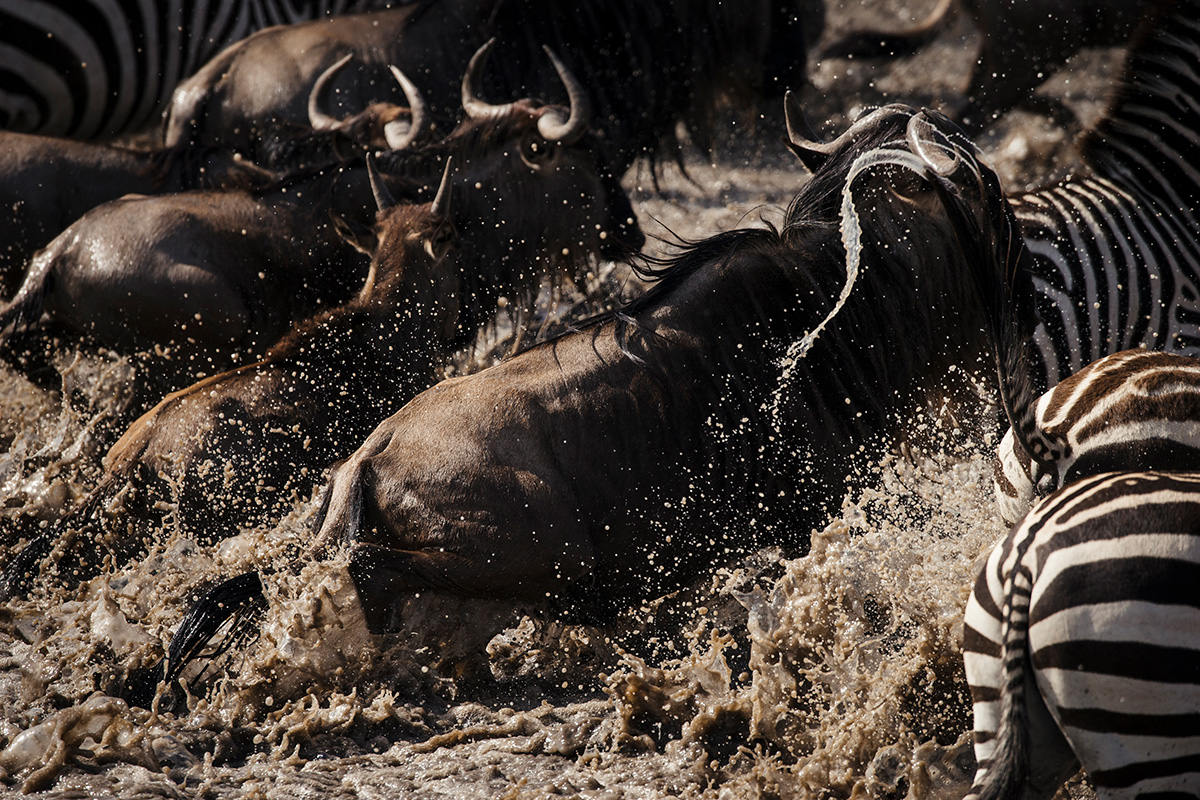
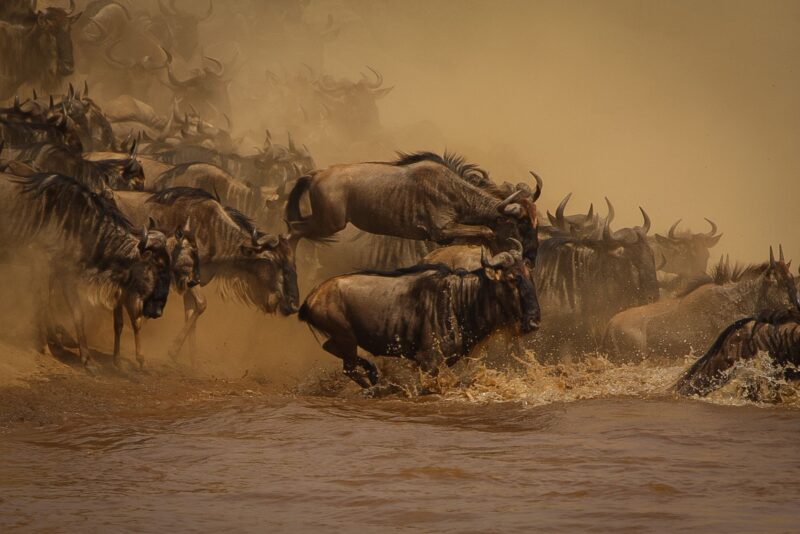
If there is one image that represents the Great Migration globally, it is the Mara River crossing. Thousands of wildebeest stacked at the riverbank, pushing from behind, hesitating at the water’s edge while massive Nile crocodiles hold completely still in the current below. Then one animal commits. And within seconds, the herd follows in a churning, leaping, swimming mass of noise and water.
It is the most dramatic and unpredictable few minutes in wildlife observation. And no two crossings are the same.
How Crossings Actually Work
Wildebeest are simultaneously compelled to cross and terrified to cross. They will gather at a crossing point, sometimes for hours, milling nervously, approaching the water, retreating, circling back, approaching again. Then, without any obvious signal, the herd commits. The trigger is often one bold individual making the first move, and the rest follow the collective momentum.
Crocodiles in the Mara River can reach five meters in length and weigh over 500 kilograms. They position themselves at known crossing points before the herds even arrive. They are extraordinarily patient predators. During crossing season they do not need to hunt, the prey comes directly to them.
Lions and cheetahs often position themselves on the far bank, waiting for exhausted or disoriented animals to emerge from the water. A crossing can go from chaos to quiet in under ten minutes, and then the cycle starts again at the water’s edge.
What determines whether you see a crossing:
- Timing: crossings at the Mara River happen predominantly July through October, with the peak concentrated in August and September
- Location: the main crossing points along the Mara River are inside the Maasai Mara National Reserve and in the adjacent private conservancies. Knowing which crossing point is active on a given day requires local knowledge and tracker communication
- Patience: witnessing a crossing requires being in the right place and waiting. Some groups wait at a crossing point for two or three hours before it happens. Some wait all morning and nothing occurs. Others arrive and the herd is already mid-river. That unpredictability is precisely what makes it electric when it does happen
- Guide quality: an experienced guide with radio contact to other vehicles and trackers dramatically increases your chances of positioning correctly

The False Promise of ‘Guaranteed Crossings
Any operator who promises you a guaranteed river crossing is overselling what can genuinely be delivered. No one controls the herds. What experienced guides can do is put you in the best possible position based on real-time herd location, weather conditions, and patterns from previous days. That is what we do. Manage expectations and stay patient, and the reward when it happens is worth every minute of waiting.
The Grumeti River Crossings: The Underrated Alternative
Most travelers focus exclusively on the Mara River, but the Grumeti River crossings in the western Serengeti during May and June are extraordinary and far less crowded. The Grumeti is home to some of the largest Nile crocodiles in Africa. The terrain around the crossing points is different from the Mara, denser vegetation, more intimate sightlines, and the crossing itself has a rawer, less-observed quality that many wildlife photographers consider to be among their best work.
If your travel dates fall in May or June, building your itinerary around the Grumeti crossings is an excellent alternative to peak Mara season.
Maasai Mara vs. Serengeti: Where Should You Be?
This is the question every first-time migration traveler asks, and the answer depends almost entirely on when you can travel. The herds do not spend equal time in both countries. The Serengeti is where the migration lives for most of the year. The Maasai Mara is where it arrives during the peak dramatic window.
|
Maasai Mara, Kenya |
Serengeti, Tanzania |
|
Best months: July to October |
Best months: year-round (varies by location within park) |
|
Famous for: Mara River crossings, big cat density |
Famous for: calving season, Grumeti crossings, vast scale |
|
Terrain: open rolling grasslands, riverine forest edges |
Terrain: endless plains, kopjes (rocky outcrops), riverine corridors |
|
Crowds: highest in August (manageable in conservancies) |
Crowds: less concentrated than the Mara in peak months |
|
Activities: game drives, balloon safaris, walking safaris (conservancies) |
Activities: game drives, hot air balloons, walking safaris |
|
Combines well with: Kenya coast, Amboseli, Laikipia |
Combines well with: Ngorongoro Crater, Zanzibar, Kilimanjaro |
|
Our properties: Olare Motorogi Conservancy, Ol Kinyei Conservancy |
Scale: at 14,763 sq km, nearly four times the size of the Mara |
The short answer:
- Travel July through October and you want to be in Kenya’s Maasai Mara for the river crossing experience
- Travel December through March and you want to be in the southern Serengeti for calving season
- Travel in May or June and the western Serengeti / Grumeti corridor is the compelling option
- Travel the full East Africa loop and see both: the Serengeti in the south during calving, then follow the herds north to the Mara
Combining Kenya and Tanzania in One Trip
Our 11-Day Kenya Safari Maasai Tsavo Coast itinerary covers the Maasai Mara ecosystem with time on the Kenya coast. For travelers wanting both Kenya and Tanzania in a single safari, we build custom multi-country itineraries. Ask us about combining the Serengeti, Maasai Mara, and Zanzibar in one trip.

Private Conservancies: Why They Change Everything
Here is what most general migration guides do not tell you clearly enough: where you sleep and where you watch from matters as much as when you go. The difference between witnessing the migration from the main Maasai Mara National Reserve at peak season and witnessing it from a private conservancy is the difference between attending a major sporting event from the nosebleed seats and watching it from the sideline.
Private conservancies are parcels of land adjacent to the national reserve, leased from Maasai landowners under agreements that provide them with direct tourism revenue in exchange for keeping the land open for wildlife rather than converting it to agriculture or fencing it for livestock. They are legally separate from the national park, and that separation matters.
What conservancy access gives you that the national reserve does not:
- Strict vehicle limits per sighting. In the national reserve at peak season, a single crossing point can attract twenty to forty vehicles. In a conservancy, vehicle numbers at any one sighting are capped — often at six or fewer
- Off-road driving is permitted in most conservancies. In the national reserve, vehicles must stay on designated tracks. Off-road access means you can position directly at a crossing point, not just at the nearest track
- Night drives are available in conservancies. The national reserve strictly prohibits game drives after dark. Some of the most extraordinary predator behavior happens after sunset
- Walking safaris guided on foot are permitted in most conservancies. This is one of the most intimate wildlife experiences available anywhere in Africa
- Balloon safaris over the conservancy at dawn offer a perspective on the herds that no ground vehicle can replicate
Our Maasai Mara conservancy lodging partners:
Back to the Source Tours works with camps in the Olare Motorogi Conservancy and the Ol Kinyei Conservancy. Both sit directly in the migration corridor and both offer all the activity access described above. Neither is inside the national reserve boundary, which is exactly the point.
Conservancy vs. National Reserve: The Practical Question
Does this mean you should never go inside the Maasai Mara National Reserve itself? Not at all. The reserve contains iconic crossing points and extraordinary big cat habitat. The best migration itineraries often combine conservancy accommodation with day drives into the reserve. That gives you the intimacy of conservancy access with the full geographic range of the reserve
Calving Season: The Migration’s Most Underrated Chapter
Everyone talks about the river crossings. Not enough people talk about calving season in the southern Serengeti, and it deserves far more attention than it gets.
Between late January and mid-March, the herds gather in the Ndutu area of the southern Serengeti and Ngorongoro Conservation Area. The short rains have turned the grass green and nutrient-rich, and this is where the females give birth. Approximately 500,000 calves are born in a concentrated window that lasts six to eight weeks. That works out to roughly 8,000 calves per day at peak.
The evolutionary logic behind this mass birth event is simple: overwhelming predators with numbers. No lion pride, no cheetah coalition, no pack of hyenas can eat 8,000 calves in a day. By flooding the landscape with vulnerable young animals simultaneously, the species ensures that enough survive. Wildebeest calves are mobile within minutes of birth and can run with the herd within hours.
But the predators are there. Every single one of them. Cheetah mothers with cubs to feed. Lionesses who have timed their own reproduction to align with calving season. Jackals, hyenas, and vultures working the edges. The result is some of the most concentrated predator-prey interaction visible anywhere on Earth, set against a backdrop of lush green plains and dramatic skies.
Why Calving Season is the Right Choice for Some Travelers
If you want to see predator behavior, raw ecological drama, and extraordinary photography conditions without peak-season crowds and at potentially lower lodging costs, January to March in the southern Serengeti is a genuinely compelling alternative to the famous Mara River season. It is less known, which makes it better for the travelers who discover it.
What to Pack for a Migration Safari
The Maasai Mara and Serengeti sit at different elevations and have distinct microclimates. Packing well means you are comfortable in both the warm midday heat and the surprisingly cold early-morning game drive departures.
|
Pack This |
Leave Behind |
|
Neutral-colored safari clothing (khaki, olive, tan, brown) |
Bright colors, neon clothing, large prints |
|
Lightweight long-sleeve shirts for sun and insect protection |
Heavy perfume or strongly scented products |
|
Warm fleece or jacket for early morning game drives (can be cold at dawn in the Mara) |
Noisy jewelry or accessories |
|
Wide-brim sun hat |
Tight, restrictive clothing |
|
Sunglasses with UV protection |
Hairdryer (most camps cannot support the wattage) |
|
Sunscreen SPF 50 |
Checked luggage that exceeds 15kg soft bag limits for bush flights |
|
Insect repellent with DEET |
Plastic single-use bottles |
|
Binoculars (8×42 or 10×42 — essential for predator spotting across open plains) |
|
|
Dust-proof bag or dry bag for electronics |
|
|
Reusable water bottle (provided by Back to the Source Tours) |
|
|
Camera with telephoto lens and extra batteries |
|
|
Power bank for long game drives |
|
Luggage Weight Limits on Bush Flights
>If your itinerary includes domestic bush flights between camps (common in the Serengeti ecosystem), be aware that most light aircraft have strict luggage limits of 15kg in a soft-sided bag. Hard-shell suitcases are not accepted. Pack in a soft duffel bag and distribute any overflow into your hand luggage. Check with us before departure and we will confirm the specific limits for your aircraft.
>If your itinerary includes domestic bush flights between camps (common in the Serengeti ecosystem), be aware that most light aircraft have strict luggage limits of 15kg in a soft-sided bag. Hard-shell suitcases are not accepted. Pack in a soft duffel bag and distribute any overflow into your hand luggage. Check with us before departure and we will confirm the specific limits for your aircraft.
Hot Air Balloon Photography
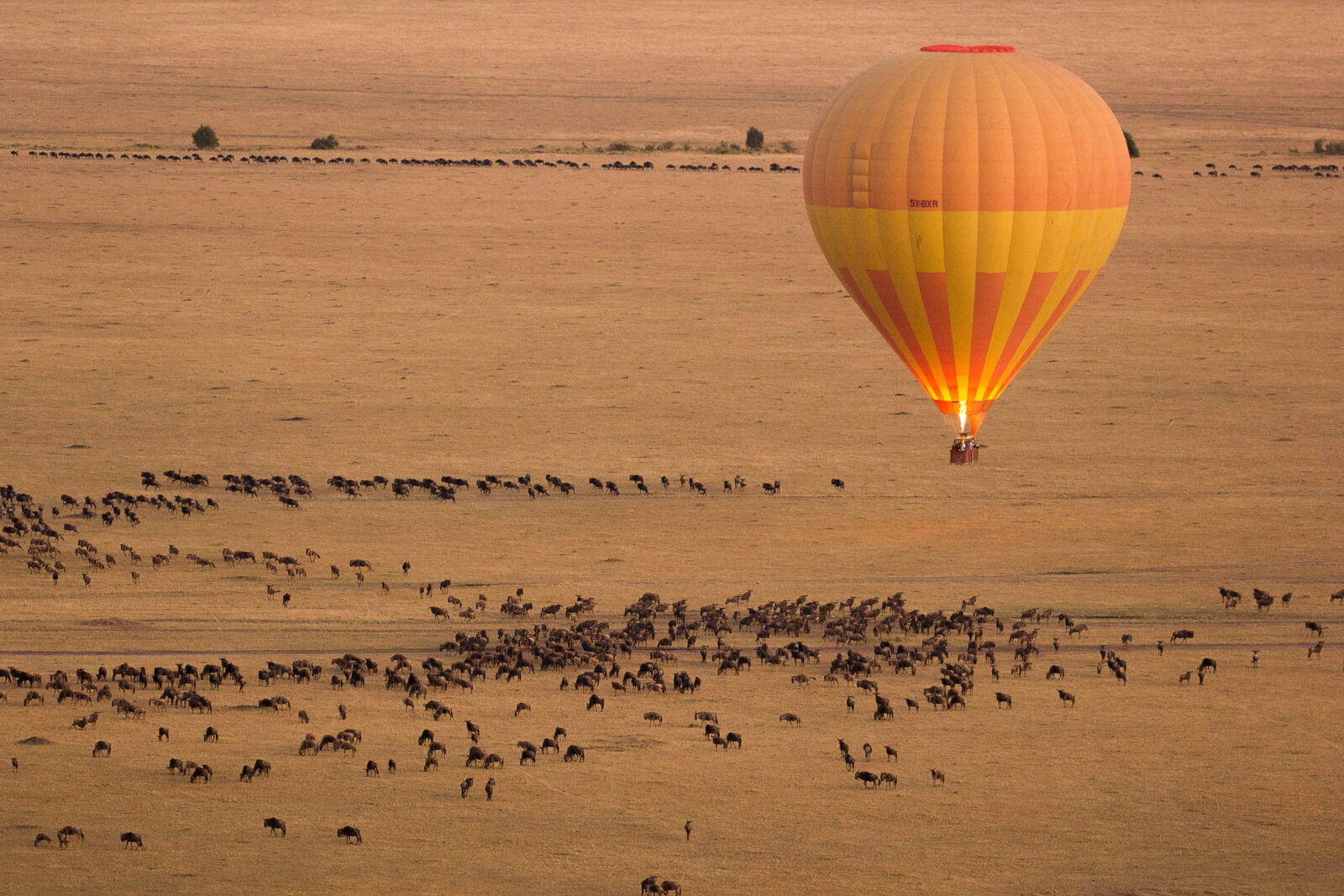
A balloon safari over the Maasai Mara or Serengeti at dawn offers a perspective on the migration that is impossible from a vehicle. The silence, the altitude, the vast herds spread across the plain below. If photography is a priority for your trip, a balloon morning is one of the best investments you can make. Ask us to build it into your itinerary.
Planning and Booking Your Migration Safari
More than almost any other safari in East Africa, the migration rewards careful timing and advance planning. Here is what you need to know before you book.
How Far in Advance Should You Book?
|
Travel Period |
Recommended Booking Lead Time |
|
July and August (peak river crossing season) |
9 to 12 months in advance minimum — camps in the Olare Motorogi and Ol Kinyei conservancies fill this early |
|
September and October |
6 to 9 months recommended |
|
January to March (calving season) |
4 to 6 months recommended |
|
All other months |
2 to 4 months generally sufficient, but earlier is always better |
How Long Should You Stay?
The migration is not a show that runs on a fixed schedule. Minimum three nights in the Mara ecosystem gives you enough time to have multiple game drive opportunities and a realistic chance of positioning for a crossing. Five to seven nights is the ideal window if your budget and schedule allow.
The travelers who leave disappointed are almost always those who allocated a single night. The travelers who come back talking about the experience of a lifetime are those who stayed long enough to let the landscape work its way into them.
Should You Base in One Camp or Move?
Both approaches work. Staying in one conservancy camp for five nights gives you an intimate knowledge of a specific territory and lets your guide learn your preferences and interests. Moving between two or three camps in the same ecosystem can expose you to different crossing points and terrain types.
For first-time migration travelers, we generally recommend anchoring in one well-positioned conservancy for the majority of the stay, with a single day drive into the national reserve to see the broader landscape. This balances comfort, depth, and range.
Do Not Try to Chase the Migration Across Borders
We see this mistake repeatedly. A traveler plans one night in the Serengeti, flies to the Mara for two nights, then wonders why they did not see more. The migration covers 1,800 kilometers a year. You cannot follow it in a week. Choose your season, choose your ecosystem, and go deep in one area. That is how you actually experience it.
The Migration and Conservation: Your Visit Matters
The Great Wildebeest Migration exists because the landscape that supports it has been protected. That protection is ongoing, imperfect, and directly dependent on the continued value of wildlife tourism to the communities and governments whose decisions determine what happens to this land.
The private conservancy model in the Maasai Mara is one of the clearest examples of tourism-driven conservation working in real time. Maasai landowners lease their grazing land to conservancies because the income is reliable and the work creates jobs for their communities. Remove the tourism revenue and that land gets subdivided, fenced, and farmed. The wildlife corridors disappear. The migration route narrows and fragments.
When you visit responsibly, stay in conservancy camps, hire local guides, buy from community markets, and follow wildlife guidelines, you are directly funding the economic argument for keeping this ecosystem intact. It is not abstract. Your permit fees, your lodge rates, and your porter tips are what make conservation economically viable for the people who live alongside it.
What Responsible Safari Looks Like in the Mara
Staying within marked tracks in the national reserve. Not pressuring drivers to get closer to animals. Not participating in off-road driving that damages habitat. Choosing camps and operators who pay their community levies. Not buying products made from wildlife parts. Following guide instructions at all times. These are not inconveniences. They are the minimum standard of respect for a place this extraordinary
People ask us sometimes whether the migration is worth all the planning, all the logistics, all the questions about timing and camps and seasons. The honest answer is not just yes. It is that witnessing it recalibrates something in how you understand the natural world.
You come for the crossing. You stay for the silence afterward, the way the plain looks when the dust settles and the last animals have emerged from the river and the crocodiles have sunk back below the waterline. The way the horizon looks just before the sun drops. The sound of the grassland at night when the hyenas start.
There is no substitute for being there. But the planning starts here. Let us help you get this right.
Ready to Plan Your Migration Safari?
We are based in East Africa. We know the camps, the conservancies, the crossing points, and the guides. Tell us your travel dates and we will build a migration itinerary that puts you in exactly the right place at the right time.
Request your personalized safari quote or contact us via email, call, or text.
Pair This Tour with More of East Africa
The migration is a centerpiece, not a whole trip. Here is how to build something unforgettable around it.
- 11-Day Kenya Safari: Maasai Mara, Tsavo, and the Coast — our signature Kenya itinerary covering the Mara ecosystem, Tsavo National Park, and the Kenya coastline
- 12-Day The Wild Experience, Kenya and Uganda — Nairobi and Maasai Mara in a focused six-day loop. Entebbe and Bwindi, Uganda
- Things to Do in Nairobi, Kenya — wildlife, culture, and city experiences before or after your migration safari
- 20 Best Things to Do in Zanzibar — the perfect beach extension after Serengeti dust
- Diani Beach Kenya: Complete Travel Guide — Kenya coast compliment to a Maasai Mara safari
- Traveling to Uganda: Everything You Need to Know — if you are combining your migration trip with a gorilla trek next door